Tuesday, May 14, 2013

5/14 Post-War Liberalism to the Present


 The modern welfare state created by the progressive reformers took shape over several decades, drastically accelerating during the Great Depression of the 1930s. In this lecture I will try trace the developments of the 1930s and 1940s into the present and show to the extent in which these debates are similar in many ways, and thus demonstrating completely how the American political system has evolved over time.

Franklin Roosevelt is sometimes considered the first "modern" president because of the massive expansion in the power and the capabilities of the state under his administration. Although other Cabinet departments had been added to the government such as the Department of Agriculture, the Department of Commerce in 1903, and the Department of Labor created during the Wilson administration, Roosevelt drastically increased the power of the president by enlarging the personal staff of the president even as he sometimes de-emphasized the role of the formal Cabinet departments.


When Roosevelt ran for president, he was already the Governor of New York (actually Herbert H. Lehman, Roosevelt's Lieutenant, was then elected Governor of New York in 1932, Lehman is who the college is named after––somewhat more infamously now, also one of the Lehman Brothers formerly of Wall St.) Roosevelt advertised what he called his "Brain Trust" a collection of university-trained intellectuals who analyzed data, did research, and created the policies that became known as the "New Deal." This is consistent with the progressive emphasis on scientific knowledge applied to politics. Voters who were distrustful of corporate executives and conservative intellectuals for all their recent failures were much more inclined to experiment with what Roosevelt offered.

The New Deal was a mixed bag of then unprecedented government programs designed to stimulate the economy, reduce unemployment, create security, and grow the economy. It was largely a success, although there was a second recession in 1937, unemployment remained higher in the U.S. than in Germany until World War II, and many of its more ambitious programs like the National Recovery Administration (NRA) which regulated the prices of goods and wages paid to workers were struck down by the Supreme Court in the mid 1930s.

In 1939, on its second attempt, The Reorganization Act is passed which gives Roosevelt the power to create additional federal offices. This Act was passed on the recommendation of the Brownlow Commission, a panel of three social scientists who studied the executive office and determined areas where they believed the president needed help. Once again, the appeal to commissions which are brought together by either the president or Congress and are still common today, is another example of how scientific knowledge is institutionalized in the government.

This also illustrates the system of checks and balances and shows that the president has to get Congressional approval in the form of a law passed, that gives the president the right to create new offices in the executive branch. The course of action was taken up, in part, because of actions by the Supreme Court which had actually dissolved offices and organizations created by the executive branch of government. In this regard, the Court was playing the traditionally conservative role that Hamilton had envisioned for it in protecting the rights of private property.

Once the president was given the authority by Congress, Roosevelt created several new offices within the executive staff, the Executive Office of the President (EOP) that forms the foundation of the modern White House Office (WHO) today. The executive office is headed by the Chief of Staff who runs the day to day affairs of the president and in many cases controls access to the president. Also, an earlier version of today's Office of Management and Budget (OMB) was created to oversee the expenses of the executive branch in the budget, as well as earlier versions of the National Security Council (1947) and the Council of Economic Advisors (1946). 

Again, in all of these cases these offices were to be staffed with scientifically trained intellectuals who would oversee the increasingly complex functions of the government. All of these offices are considered, along with the office of the Vice-President, "Cabinet-level" and are thus on an equal status with Cabinet departments, and again, in many cases the presidents have come to rely on the advisors in the EOP more than the Cabinet. Since then, even more executive offices have been created like the Office of the Trade Representative (1962); Office of Environmental Quality (1969); and the Office of National Drug Control Policy (1989), as well as others.


The 22nd Amendment was introduced in 1947 and ratified in 1951, thus explicitly limiting the number of terms a president could serve to two, or a maximum of 10 years if they assumed office as a Vice-President. In between this time, the Republican Party once again came to dominance which culminated the following year when Dwight Eisenhower (1953-1961), the Allied Commander during World War II, was elected President. 

The major issue driving the election was foreign affairs, specifically the threat of Soviet Communism. Although during World War II, U.S. propaganda referred to Soviet dictator Joseph Stalin as "Uncle Joe" when the Russians were allies against the Germans, after the defeat of Nazi Germany in 1945, a new conflict emerged between the U.S. and the Soviet Union over the fate of Germany and the rest of Europe. By the end of the 1940s, the conflict had extended to the entire world. It is after this period of time that the U.S. begins to transition into the role of global superpower, a reversal of its traditional non-interventionist position throughout most of its history. The shape and design of many international institutions today are clearly influenced by the U.S. political system as is the still vague and undefined notion of "international law." This has created impressive new challenges to balance the requirements of democratic government with the sensitive nature of geopolitical affairs. In many regards the demands of specialized technical knowledge has only increased the distance between the government and the public.

The most traditional role the President has had is dealing with foreign nations especially including the command of the military. In the post-war era, the office of the Presidency was reformulated into the untraditional role however of maintaining global order.


After the war, Germany was divided up between the allied powers before being finally separated into East and West Germany in 1949. The period between 1945 and 1949 is a strange period of time because it is a lull in between the end of World War II and the beginning of the Cold War between the United States and the Soviet Union which continued on and off until the Soviet Union was dissolved in 1991. During these four years the U.S. and Soviets were unlikely allies who slowly became bitter enemies. The Soviet Union exploded their first atomic bomb in 1949, also ending a brief four year dominance of when the U.S. was the sole nuclear power in the world, after becoming the first, and so far only, country to use atomic weapons in war in 1945 against Japan.

In 1949, the Chinese Communist Party under Mao Zedong successfully defeated the opposition led by Chiang Kai-shek, whose defeated Kuomintang party was forced to flee to the isle of Formosa, now known as Taiwan, an island claimed by the communists on the mainland as well. This conflict is still unresolved today. Republicans in the United States attacked Democrats for their perceived weakness towards the Soviet Union and blamed them for "losing China to communism" something they swore would not happen again.

 In 1950, the Korean War began after communist North Korean (supported by China and the Soviets) forces overran the South. The U.S. intervened. This was the first war the U.S. fought since World War II. The war turned into a stalemate, after China and the United States both entered the war against each other. The inability to resolve this conflict also contributed to the Democrats defeat. In 1953, under Eisenhower, a ceasefire was signed, today North and South Korea are still separate. 3-4 million North and South Koreans are estimated to have been killed and approximately 1 million Chinese soldiers.

This was a preview of what became known as "proxy war" where conflicts between the U.S. and Soviet Union would not be fought directly between the two but through "allied" countries. In the 1950s, organizations like the CIA under the directorship of Allan Dulles, whose brother was the Secretary of State under Eisenhower, John Foster Dulles, took on an active role in promoting U.S. interests abroad even to the extent of supporting revolutions against unfriendly governments and political assassinations. In future conflicts, both countries would try to minimize their direct presence in war. Sometimes this was not successful as in the Vietnam War and Afghanistan (which used to ironically be the Soviet Union's version of "Vietnam" in the 1980s, now we have our own war in Afghanistan to compare to Vietnam). However in countries like Angola in the 1970s, and Nicaragua in the 1980s, the superpowers were ability to manipulate events from the background in a form of "covert war" even as these countries descended into bloody civil war.

During World War II, Japan had conquered the colonial empires of the British and the French in the Pacific and Southeast Asia. This had the unintended consequence of creating nationalist movements in these countries that fought, first, the Japanese and then later the remnants of the European colonial empires. The most important French colony was the province of Indochina. France continued to claim a right to rule this territory after the war which it tried to enforce until 1954 when the communist forces in Indochina under Ho Chi Minh defeated the French, leading to the province being split into different countries: Cambodia, Laos, and most notably North and South Vietnam. The French appealed to the U.S. for assistance and basically filled the void of the departing French. Ho Chi Minh also appealed earlier to the U.S. writing several letters to then President Truman (1945-1953), invoking The Declaration of Independence as a model for what the Vietnamese were trying to accomplish in their own country. Truman never responded. The U.S. tried to support the capitalist South Vietnamese government, until 1963, when the CIA ordered their own puppet leader of South Vietnam to be overthrown and killed. This signaled the direct take over of the war effort by the U.S. (only 20 days later U.S. President John F. Kennedy was also assassinated in Dallas, Texas).

By the time of the Kennedy administration (1961-1963), Americans had been forced to take an interest in foreign affairs that, historically, had gone against the habits of most generations of Americans before this. The U.S. is similar in this regard to other large nations like China which historically have also tended to be more insulated and inward focused and less concerned with foreign affairs. The U.S. was very late to get into the game of accumulating overseas colonies, and there was tremendous resistance in getting the country involved in World War I and even World War II. Both wars had been going on for over two years before the U.S. intervened. Ironically, it was not until the U.S. was actually attacked by Japan when the Japanese navy bombed Pearl Harbor that Roosevelt could gain the support to declare war on Japan. Now, the doctrine of "preemptive war" used to justify the invasion of Iraq in 2003 means we can attack a country before they have attacked us.

Kennedy represented to many, the kind of "New Americans" that were taking shape in a new United States, one that had now undoubtedly become a superpower that had tremendous influence across the world. By 1890, the U.S. had already become the dominant economic power in the world with more wealth than Great Britain, Russia, and Germany combined, but it took almost another fifty years until the U.S. became the dominant military power in the world as well (or arguably the second most powerful after the Soviet Union at that time). JFK was also, like FDR, a very media friendly politician. However, while Roosevelt was still limited to the technology of radio, Kennedy made great use of the television medium. It is around the same time that conservatives start creating the ideology of the "liberal media," to attack the credibility and reliability of the media mostly coming from the Richard Nixon campaign who is running against Kennedy in the 1960 election and is the Vice-President under Eisenhower. Ironically, while many of the arguments against liberal bias are credible, many of the claims made about Nixon turned out to be true, which is often not acknowledged by conservative critics of the media.


In the 1960s, the conservative movement started to reassert itself after its devastating losses in the 1930s and 1940s. What had happened to the Republican Party in the 1930s was similar to the Democratic Party in the 1860s. It became so identified with something so negative (slavery, or causing the Great Depression in this case) that it took literally decades for it to repair the damage to its image. In the 1950s, a Republican president reigned, but Eisenhower had adopted virtually every major program introduced by the New Deal and after, in other words Eisenhower was a very moderate republican and in many ways tended to be liberal especially on domestic policy, in fact it was under Eisenhower the first school desegregations were ordered like in Little Rock, Arkansas in 1954. In 1964, the Republicans ran Arizona Senator, Barry Goldwater against Lyndon B. Johnson (1963-1969), Kennedy's former Vice-President, and someone who modeled himself after FDR, even calling himself LBJ. Johnson won in one of the biggest landslides in American history. 


1964 U.S. Presidential Election

At the time, in American political culture, there was a strong commitment among the public for social welfare policies and programs for the poor. Programs like Medicare and Medicaid were created under the Johnson administration as well as the new Cabinet Department, the Department of Housing and Urban Development (HUD). Johnson also presided over the passage of the Civil Rights Act of 1964, outlawing legal segregation and the Voting Rights Act of 1965. Along with these landmark legislative acts, the "Civil Rights" Amendments were passed in the Constitution:

  • 23rd Amendment (1961): Allows Washington D.C. to vote for president which previously had no representation in the electoral college.
  • 24th Amendment (1964): Prohibits a poll tax, literally a fee paid to vote used especially in the South.
  • 25th Amendment (1967): Establishes the presidential line-of-succession, like the 20th and 22nd amendments, this amendment reflects the growth of executive power and its importance.
  • 26th Amendment (1971): Passed during the height of the Vietnam War, this amendment lowers the voting age to 18 from 21.

Three of these Constitutional amendments deal with the crucial issue of the right to vote in a democracy which was also the focus of the Voting Rights Act of 1965. However, electoral laws are mainly decided by the state, and there has recently been a determined effort by many Republican governors of states like Florida to "purge" registered voters from the voting lists and thus take away their right to vote under the pretext of preventing "voter fraud." It might seem strange that a party that claims to be working in the interest of the majority of people would put so much effort into reducing the number of eligible voters, and many liberals have argued this is an attempt to undermine the Voting Rights Act.


After Kennedy's suspicious assassination in late 1963, plans were set in motion to escalate the war in Vietnam beginning in 1964. A fictitious assault on U.S. naval vessels was used as a justification to escalate the war, which by 1968 had over 500,000 U.S. servicemen in Vietnam. The combined stresses of the Johnson's domestic welfare programs and overseas wars began to take its toll on the American economy which began to show signs of inflation.

The United States became overwhelmingly the dominant economic power in the world after World War II. At one point it was responsible for almost half of the world's entire industrial output. This was the material basis of the so-called "Baby Boom" generation in the United States, which reaped the full benefits of the U.S. post-war prosperity in the 1940s, 1950s and early 1960s. It is during this period of time the mythical image of the American way of life is constructed which still resonates today. However often unacknowledged is that the super prosperity of the U.S. during this time was primarily because the other major industrial powers of the world were rebuilding from World War II. Not surprisingly the two most dominant industrial powers after the U.S. before World War II were Germany and Japan. By the late 1960s and especially in the 1970s, exports from these countries was seriously eroding U.S. economic power. Arguably the U.S. has never recovered from this and has pursued a series of artificial means of preserving itself largely through uncontrolled deficit spending, both public and private.
Trade Statistics 1930-2005
Bureau of Economic Analysis


On top of all this, the public had hardly gotten over the public assassination of John F. Kennedy in 1963, when Martin Luther King Jr. and Robert F. Kennedy, the brother of John Kennedy, were both assassinated within months of each other a few years later in 1968. 

Robert Kennedy had also been the favored candidate  in the upcoming Democratic primary for the election in November. Instead, with all the chaos and the demoralization of Kennedy's death, Richard Nixon was elected president in 1968, and re-elected again in 1972, although the illegal tactics used during his re-election would lead to his downfall and resignation in 1974, the only president so far to resign in office. 

A major factor was that after 1964, the Democratic party largely lost the Southern vote to Republicans. The Democrats had been a force in the South since the founding of the party in the 1790s. Johnson reportedly remarked as he was signing the Civil Rights Act in 1964, "we have lost the South for a generation." Many have accused Nixon and other Republican presidential candidates as playing to Southern racism without being explicit about it, sometimes called "symbolic racism" or "institutional racism."
1968 U.S. Presidential Election
George Wallace was a segregationist third party candidate


In 1968, Nixon had won the Republican primary against a number of challengers including Ronald Reagan who was the Governor of California. Reagan at this time was seen as an extreme conservative compared to Nixon and other "establishment" Republicans. Reagan ran again for the nomination in 1976, and almost won the nomination away from the incumbent President at that time Gerald Ford. 

The primary system had actually been established by the progressives early in the 20th century. Prior to this the party's candidate for elections was selected by party leaders, however the primary then made the candidate selection process a matter of direct voting by members of the party. Reagan's popularity in 1976 was seen as a reflection of the growing strength of the conservative movement in this country, which reached its culmination in the 1980s, beginning with the election of Ronald Reagan as president in 1980.


The Reagan administration was defined by the phrase "government is the problem" and tried to remove the government from every area of government regulation and intervention which had developed since the beginning of the century. Despite this, the budget deficit of the federal government continued to grow tremendously through the decade, along with an increasing trade deficit which also been growing rapidly since the 1970s, and despite Reagan' promises to tackle the "twin deficits." 

The budget deficit grew largely because of a combination of increased military spending and significant tax cuts given to the highest income brackets in the country. Reagan was later forced to reverse many of these tax cuts and ended up raising taxes several times.  Much of the increased military spending was used to finance covert wars in Latin America and the Middle East, but also to "outspend" the Russians on defense, a process that some commentators believe helped pushed the Soviet Union into its final downward spiral into dissolution.

During this period of time a book entitled The Wise Men (1986) was published chronicling the events of several of the most influential political operatives in foreign policy (the term wise men of course also has religious significance). It followed the careers of six men: W. Averell Harriman, Robert A. Lovett, William Bohlen, George Kennan, John J. McCloy, and Dean Acheson. The authors spend the majority of the book convincing their readers that these men were non-ideological, bipartisan, in short "above the fray" of conflicts that normally characterize politics. 

However, the notion that they were above ideology seems strange when it is so obvious how militantly anti-communist these men were. Harriman, McCloy and Lovett all for example had connections with Nazis stemming from World War II. These men were instrumental in developing the "containment" strategy that was invoked in the Korean and Vietnam wars, and coups or attempts at a coup in several countries including Iran, Guatemala, the Democratic Republic of the Congo, and of course Cuba. Several other men who moved in the same circles were conspicuously omitted like John Foster Dulles, Secretary of State under Eisenhower, and his brother Allen Dulles, director of the CIA until the Bay of Pigs invasion of Cuba in 1961, who were so directly involved in overthrowing foreign government and assassinations that including them as "wise men" would probably be too controversial. Another notable omission is James Forrestal, the last Secretary of Navy before the Navy and War departments were combined into the new Department of Defense after World War II, and became the first Secretary of Defense. Forrestal another militant anti-communist who was becoming increasingly paranoid and suffering from mental breakdown later committed suicide in 1949.

It is reasonable to question how appropriate it is to call someone wise when they were unable to foresee that the consequences of establishing brutal and corrupt "puppet dictators" who oppressed their own people would one day come back to haunt the U.S. The term used for this by intelligence operatives is "blowback," and the most famous example could be the Iranian revolution in 1978-79 which began after enduring 25 years of the tyrannical Shah of Iran after a U.S. sponsored coup in 1953. Although many of these men were too old to play a direct role in the 1970s and beyond, these same ideas were put into effect to train and/or fund men like Osama Bin Laden to fight the Soviets in Afghanistan, and Saddam Hussein to fight Iran in the 1980s. Most Americans are not even aware of the huge death tolls as a result of U.S. wars in Southeast Asia, almost 4 million Vietnamese killed and maybe more than 2 million neighboring Cambodians and Laotians. Between half a million to a million Indonesians were killed in another U.S. supported coup running parallel with the Vietnam war in 1967. If you add in the death toll number from the Korean War which is not in Southeast Asia, then you have approximately 12 million Asians killed between 1950-1980, or roughly twice as many as the number of Jews killed in the Holocaust by the Nazis from 1942-1945 and about the same number overall of all the people who died in the Holocaust.

To label people as ruthless and dogmatic as this wise is not so shocking when you consider the difficulty of thinking outside the perspective of "irrational Lockeanism." Similar ideas of the "end of ideology" or even the "end of history" after the Cold War have been used by conservatives time and again to hammer in the point that private property owned and controlled by large corporations and liberal-democracy driven by interest groups are the normal and natural ways of life for everyone. In the 1980s especially there was a strong tendency to mythologize the American way of life in what can be seen as an attempt to break away from the terrible legacy of the Vietnam War and a stagnant economy since the late 1960s, aided greatly by the ever-developing mass media industries.


The trade deficit continued to grow in the face of competition from Germany and Japan after the 1960s, and the inability of major U.S. corporations like General Motors to adapt and innovate their product designs, as well as decreasing quality in the automobiles themselves, compounded by multiple Arab oil embargoes in 1973 and 1979. Despite advances in several high-tech U.S. industries revolving around the emerging computer industry in the 1980s, the U.S.'s overall trade deficit continues to rise even today. 

 Significant pressure has been used to create tariffs to protect domestic U.S. industry at the expense of open trading relationships with other nations and higher consumer prices on goods. This did not prevent President Reagan from winning the largest landslide in American history, over a very anemic and weak Democratic party.
1984 U.S. Presidential Election


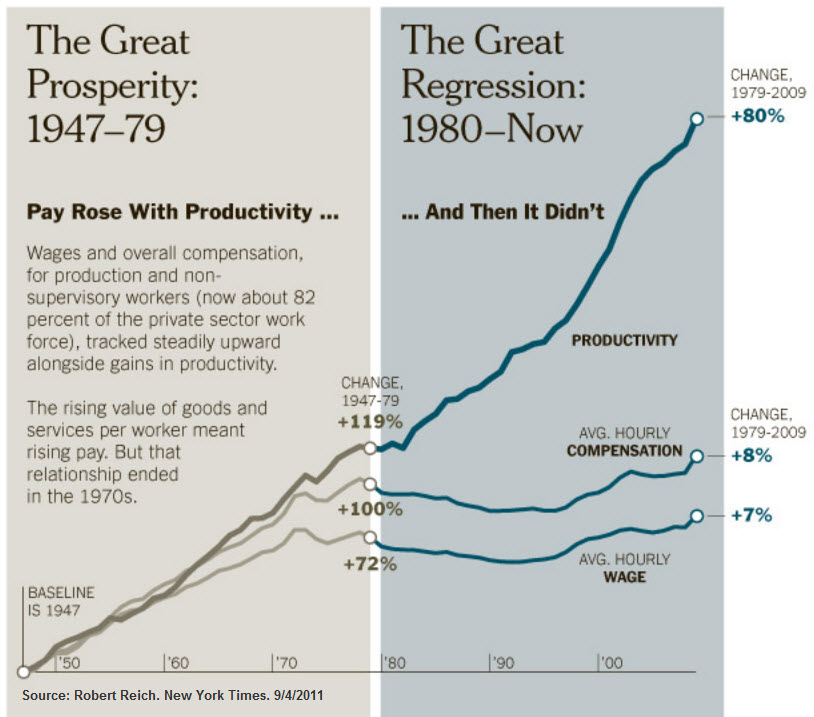
Overall the U.S. economy grew during the Reagan administration, even as the share of the national income was increasingly concentrated in fewer hands, a trend that began in the 1980s and has continued to accelerate into the present. Poverty increased during the Reagan administration at the same time in which scandals emerged over Reagan's HUD Secretary misappropriating funds to rich associates rather than directing the money to develop housing projects in urban areas. Many commentators pronounced the return of the "Gilded Age." On the other side, Democratic opponents of Republicans usually point to the Post-War Liberal era as the time of greatest productivity in the U.S. and favor policies that attempt  to bring back the New Deal.
Robert Reich, former Secretary of Labor under Bill Clinton (1993-2001)
The chart is meant to show that even though economic productivity increased in the 1980s, the actual wages of working people did not keep pace with this change. Also, that productivity was greater during the social welfare period of the New Deal and that wages and incomes raised in proportion with the increase in productivity


This development came to a climax in 2008 when the biggest stock market crash since the Great Depression occurred as a result of too much financial speculation in the U.S. housing markets. This was in large part a result of the "deregulation" of the financial industry beginning in the 1980s, overturning laws established in the 1930. Unlike the Great Depression which began in the middle of a Republican administration and helped to discredit the Republicans for more than 40 years, this one exploded, or was timed to explode, shortly before a presidential election, the 2008 election which saw the election of Barack Obama. 
2008 U.S. Presidential Election
"Battleground" states are states that do not have either a solid Republican or Democratic majority
In many regards the divisions into North and South regions still exists
President Obama has so far tried to adhere to a "consensus" approach to politics which has so far produced mixed results at best. Much like Jefferson, another controversial figure of his time, appeals to the unity between Federalists and Republicans, Obama has in many of his speeches appealed to common sentiments between Democrats and Republicans. However, unlike Jefferson whose party came to dominate politics in America, the Obama administration has not had a clear majority in Congress and has had great difficulty in getting legislation passed. This is a function of the system of checks and balances as intended in the Constitution, but as critics have pointed out, often this system creates paralysis in government.

After the election of 2012, however it appears that President may have more leverage to put through his policies even though the House of Representatives still has a Republican majority. Note also the similarities between the election results of the previous election, and the changes in certain "battleground states."


Obama, for obvious ideological reasons, seeks to portray himself in the lineage of Jefferson and Lincoln. Obama addresses the issue of race in a way Lincoln never could by drawing upon his own experiences with racism, especially as a child of mixed race who has insight into the attitudes of whites and blacks. His association with black radicals like the Reverend Jeremiah Wright, has also pushed the president to defend the legitimate anger and resentment many African-Americans feel towards a system of government which has often failed to meet their needs.

As most Democrats look to the New Deal era of FDR and LBJ as the high-point of the Democratic party in the modern era, he has tried to expand upon these policies. Most notably, healthcare which Roosevelt stipulated was a right, and advanced by Johnson who established Medicare and Medicaid. 


The current president has also kept in place the coercive and intelligence apparatus created during the Bush administration to fight the "war on terror." So far nothing as radical as the programs set up in the 1930s has been attempted. Obviously however the circumstances in which they find themselves has changed drastically, Roosevelt for example could still count upon "the solid South" to support Democratic policies and a strong majority in Congress.


Towards the end of the class we emphasize more the Executive branch of government over the other three. That is simply because the President is the most important branch of government today, and one that has grown significantly in power over the last 80 years. Obviously the system of checks and balances is still in effect, but the influence of Congress over national affairs has declined steadily since over the last two centuries, especially in important areas like the ability to declare war on another nation. The President is also the unchallenged leader of the unofficial "civil religion" shared by most Americans.

The Supreme Court continues to be more outside the fray of the political conflicts as per its function. However, both right and left-wing activists have repeatedly criticized major decisions of the court and accuse the court of descending into partisan politics. On the right-wing side, most notably over issues like abortion. On the left-wing side, controversial decisions like awarding the 2000 election to George W. Bush continues to be a topic of debate regarding the legitimacy of this decision by the court. More recent examples include decisions over corporate campaign spending and "corporate personhood." However, the last major decision to come out of the Supreme Court has upheld the constitutionality of the Affordable Health Act, otherwise known as Obamacare, despite its perceived conservative bias under Chief Justice John Roberts.

However, the Presidency is the branch of government that really drives these debates forward. As you can see the issue of healthcare goes at least as far back as FDR's "Economic Bill of Rights."


Tuesday, March 12, 2013

3/12 The Constitution and the Federalist

"Scene at the Signing of the Constitution," Howard Chandler Christy, 1940, U.S. Capitol, Washington D.C.


The Articles of Confederation established the first system of government, first ratified in 1777 and again in 1781. The period between 1783-1789 the government was organized according to the Articles of Confederation. Notably, this system of government had no president, there was a Congress of the Confederation but there was only one branch or house, instead of two, and there was no supreme court. The 13 states which were really more like separate countries at this point and had very broad powers, maintained their own state militias, and in many cases even printed their own money and came up with their own rules on trade. The general consensus on this period of time was that the government was weak and ineffective and as a result of this conflict and disorder was increasing within the states and even between the states.


In 1786, the Annapolis Convention met in Maryland. The major result of this convention was an agreement to set another Convention in Philadelphia with purposes of "amending" the Articles of Confederation. The result was between 1787-88 the Constitutional Convention met and produced an entirely new document and with that an entirely new system of government. This is the Constitution that most people are familiar with.


The Constitution is a rather short document consisting of seven articles that broadly lay out the powers and responsibilities of the government and its operation. You may have noticed The Declaration of Independence was not very long either. When we look at the speeches of Abraham Lincoln who delivered two of the greatest if not the greatest speeches in American history, they are also very short. When your aim is to persuade people often times keeping things short works much better than writing long volumes of text. 
Public meetings and gathering-places were thus an integral part of the political process and a means by which "ideology" or a set of political beliefs and attitudes, becomes meaningful for individuals. 

There were many debates within the Convention (the official records of which are still sealed). Many of the conflicts revolved around sharing power between the large states and the smaller states; questions of national debt and state debt incurred during the war; and of course slavery.


The first three articles set up the basic separation of power between the Legislative, Executive, and Judicial branches of the federal government. Many of the Enlightenment thinkers like Locke or the French thinker Montesquieu (1689-1755) adopted similar frameworks for the division of power and it has become accepted as standard in virtually every government in the world. 


Originally, the legislative branch (the law-making part of government) was supposed to be superior. This was meant to place a check on the power of the "king" and also to protect the "private property" of individuals. The executive branch which is charged with physically carrying out the laws is thus dependent on the legislature for funding (it must get its permission more or less) and the power to raise taxes rests with the legislature as well. 

The Legislative branch is entrusted with making all laws for the country and is composed of two branches: the House of Representatives and the Senate. Representatives are drawn based upon the population of the state. Larger states with larger populations have more representatives. Also if the population of the state increases past a certain point it will gain more representatives (or lose them if the population decreases). Representatives are drawn from different districts drawn up by the states who also control the laws for voting in their respective states. All bills for raising revenue are supposed to originate with the House since it is the more democratic branch of government. Because of its size the position of a Speaker for the House is created as well. The Senate is composed of two senators from each state regardless of size. This was intended as a compromise to give smaller states more equality in government. Senators were originally chosen by the state legislature, and not by the people directly, that lasted until the Progressive era in 1913.
 

In order for proposed legislation to become law it must pass through both houses of Congress and be approved by the president. The president can veto laws, but the Congress can override the veto if it gets a 2/3 majority in both houses. 


This is probably the most well-known example of the second major principle guiding the Constitution, the system of checks and balances. Similar to the separation of powers, this principle stipulates that the different branches of government have to be in agreement on major decisions and that each branch has the power to limit the power of the other branch. The idea of separation of powers would be pretty much meaningless if it did not include this as well. These two principles were designed above all else to prevent tyranny, even at the expense of effective government, or what Hamilton would call "energetic government." 


This is controversial, because although preventing some (not all) abuses of government authority, it makes it difficult to use the government for more constructive purposes, leading to what is called "gridlock." This is a common topic in the present because of the noted Republican opposition to the Obama administration. In this case, Republicans control the House of Representatives while the Senate is nominally a Democratic majority, so even controlling one part of the Congress is enough to effectively stall any programs or policies favored by the current administration. However, this is complicated because in the Senate at the present the rules have effectively changed to now require a 2/3 majority to pass legislation through instead of a "simple" majority (n > 50%). This is as a result of what is called the "filibuster" and its notable because it is NOT in the Constitution.


The first article is the longest, again an indication that the legislative branch is supposed to be the most important and lays out several other responsibilities of the government over things like immigration and trade. 


There is also the Commerce Clause in Section 8: "To regulate Commerce with foreign nations, and among the several States, and with the Indian Tribes." This short passage actually provides the legal justification for Congress to pass laws regulating things like healthcare or even drugs which are made "illegal" by an act of Congress. 


There is also the Necessary and Proper Clause: "To make all Laws which shall be necessary and proper for carrying into Execution the foregoing Powers, and all other Powers vested by this Constitution in the Government of the United States, or in any Department or Officer thereof." This clause is controversial because it gives power to Congress to pass laws "necessary" to accomplish its goals. This of course sparks controversy over how the Constitution is interpreted. 


Some favor what they call a strict interpretation of the Constitution meaning the government has no right to pass any laws or act in any way not explicitly mentioned in the Constitution. This interpretation is mostly used by conservatives to limit the government's ability to regulate business or provide "privileges" to minority groups. Others favor a more broad interpretation of the Constitution and use this clause as a legal justification.


The second article deals with the executive branch of government headed by the President of the United States. This article explains the controversial electoral college, an institution that was set up to prevent presidential elections from being decided directly by the people. Instead votes are allocated based upon a number of "electoral votes" possessed by the individual states not by the people of the states. So when we count the results of the election we count the states the president won, not the people who voted for the president. This system tends to benefit the less popular candidate: some elections that were very close in terms of popular vote seemed like huge victories in terms of electoral votes, some have even lost the popular vote and still won in the electoral college like George Bush in 2000 (even counting Florida, Bush still lost the popular vote, however the results of that election are too distorted to use this as a good example of "winning" the electoral college while losing the popular vote). 


The major flaw in the electoral college is the idea of "wasted votes." Consider a state like New York. Since New York traditionally votes for the Democratic candidate in Presidential elections (it did go for Reagan though twice in the 1980s) only one vote more than the Republican candidate or third party candidate receives is necessary to win the election. To use simple numbers if a Republican gets 1,000 votes in NY, the Democratic candidate only needs 1,001 votes to receive the electoral votes for the whole state. If it turns out 5,000 people voted for that candidate, then most of those votes will be wasted, in the sense that they will not add anything to the chances of the candidate winning the election. Now consider the real life population demographics and the fact that the population of New York overwhelmingly outweighs the populations of so many other states with a few exceptions and it is easy to see why many would criticize this system since the citizens of New York would be under-represented compared to smaller states that would have a disproportionately larger influence in determining elections relative to their population size.


In terms of "electoral systems," or a way of selecting candidates for election, this is known as single-member district (SMD), and all elections in the U.S. are decided this way including for Congress and local government as well. An alternative method is known as proportional representation, where the proportion of votes captured by a political party equates into the proportion of representatives they have in the legislature or Congress. In this system votes are not wasted, to go back to our example, all of the votes cast in New York will then go towards the overall proportion of votes received by a party which would increase the proportion of their party representatives in Congress. However in this system there is less of a personal relationship between members of the legislature and their voters or constituents. The SMD system, since it focuses on a specific person in a specific district tends to establish more of a personal relationship between the candidate and potential voters.

The impeachment process is also explained in Article II as it is in Article I. A president can be impeached or removed from office but it has to follow a precise procedure. The House must formally lay charges against the president, the Senate then becomes like a court where the president is tried. The House brings the charges and acts as prosecutor, but the Senate votes on it and acts as jury. 

There have only been two impeachments in U.S. history against Andrew Johnson after the Civil War for supposedly sabotaging Reconstruction in the South, and Bill Clinton in the late 1990s for having sex with someone who was not his wife and then lying about it, or as Republicans called it "obstruction of justice." However the Senate voted against impeachment and they were not removed from office. 

The primary responsibility of the president is dealing with foreign affairs, and in this area the president has more room to act without the approval of Congress. Notably, the power to "declare war" on another country rests with Congress, yet this is another aspect we do not follow anymore, there has not been a "declared" war since World War II. 

An unwritten role of the President is to be the leader of the civil religion, much in the same way as religions often have a "supreme leader."

The third article deals with the Supreme Court and the Judicial branch which is charged with interpreting the laws of the country in reference to the Constitution. Although not provided in the Constitution this evolved into the power of "judicial review" which gives the court power not only to interpret laws in reference to the Constitution in specific cases, but to strike down or cancel laws which conflict with it. 


The article also separates "original jurisdiction" from "appellate jurisdiction." Original jurisdiction refers to cases that would go directly to the Supreme Court. They are fairly few mostly affecting cases involving foreign officials, federal officials, or if the U.S. itself is a party in a case including treason. Most of the time, and most of the famous cases that have come before the court, the court was acting in terms of its appellate jurisdiction or appeal. People appeal to the Supreme Court after they have gone through lower courts, although the Supreme Court can choose not to hear a case. Most crimes are under the jurisdiction of the state court, including the most serious crime murder. If you kill someone you will most likely be tried by the state not the federal government, unless you kill a federal official. However the Supreme Court does have the power to override the decisions of lower courts.

The remaining articles deal with the relationship between the federal government and the states, the process of adding amendments to the Constitution, and the process of ratifying or approving the Constitution. Following that is a list of the Bill of Rights and the other amendments to the Constitution. We will talk about the Bill of Rights more next class. Article IV deals with some of the rights of the states and their relation to the government. The U.S. government is set up as a federal system, this means there is a division of power between the U.S. government, the state governments, as well as local municipal government. These different levels of government also follow the Legislative, Executive, and Judicial division of power. The American political system is very complex because of this. Many states like France, the United Kingdom, and Japan have unitary states meaning there is one government authority and all local officials are usually appointed by higher officials. Germany has a federal system, although it is only made up of 16 states instead of the 50 states now in the U.S. (originally 13 of course). India is also a federal system made up of 28 states and 7 "union territories" directly administered by the federal government. Russia is a federal state made up of 83 different units. A federal system is most common in countries where there is either a lot of ethnic division like in Russia or India or smaller autonomous states are now part of the unified federal state like in the case of the U.S. or Germany.


There is a controversial passage in Article IV that protects slavery: "No person held to Service or Labour in one State, under the Laws thereof, escaping into another, shall, in Consequence of any Law of Regulation therein, be discharged from such Service or Labour, but shall be delivered up on Claim of the Party to whom such Service or Labour may be due." There is also a clause in Article 1 Section 2 that refers to counting slaves as 3/5 of a person for determining representatives and taxes. 


There was a small controversy over this when in early 2011 the new Republican majority House of Representatives began their session by reading out the Constitution, however they omitted these controversial passages. How would you interpret something like that? What is the meaning of reading out the Constitution word-for-word except to symbolically show that they are adhering to the "true principles" of the Constitution and implying that the country has lost its way perhaps. Yet does it not defeat the purpose when it seems that they are not willing to confront the "bad" aspects of the American past, in effect by basically censoring aspects of American history that do not fit into the idealized vision of American history that conservatives tend to put forward? It undermines the whole idea that they are trying to return to the "true" America, when their idea of truth is so selective and sanitized, or at least they are unfamiliar with the saying, "the truth hurts." This has serious consequences considering that many believe that it was the failure to discuss slavery candidly and honestly in a system supposedly based on discussion and debate that eventually led to the breakdown of the system and the Civil War (the word "slave" or "slavery" is nowhere mentioned in the Constitution). There are those who believe the Civil War would have happened earlier if they did have this honest discussion, and there were those who were willing to have this discussion even back then but who were outside the political system, however, if anything these kinds of "oversights" today are suggestive of a failure to learn the lessons of history more than anything else. 

After the Convention had completed its work, copies of the Constitution were circulated throughout the states. People in the states elected delegates to serve on state conventions to ratify the Constitution. The first state to ratify was Delaware in late 1787, New Hampshire was the decisive ninth state to ratify in June 1788. Nine states out of thirteen provided the 2/3 majority needed to ratify the Constitution. Two states, North Carolina and Rhode Island did not ratify the Constitution till after George Washington was elected president. The system of government established officially went into effect March 4th, 1789. Washington was inaugurated as president April 30th, 1789, the only president to be unanimously elected (both terms).


However between 1787-88, there was a chance the Constitution would not be approved. Next class we will look more at the opposition to the Constitution. Supporters of the Constitution who favored what they saw was a stronger government being created under the new system began to refer to themselves as "federalists" for the support of the federal system of government. Opponents who favored more power to the states and wanted to keep the federal government weak were referred to as "anti-federalists." 


In order to persuade the public to support the Constitution several of the leading "federalists" James Madison (1751-1836) who would become the 4th President of the U.S., Alexander Hamilton (1757-1804), and John Jay (1745-1829) anonymously published articles under the pseudonym Publius. As I have said with ideology, these articles attempted to interpret events of the day: in this case that the Constitutional Convention has produced a document that is "good" for the people to approve of and should be ratified. 

The articles were published first in New York newspapers but then reprinted throughout the country. They were intended to persuade a large segment of the public to adopt certain values or even to act in a certain way. They have been collected in book form and are referred to as The Federalist Papers or more simply The Federalist and are still considered the definitive interpretation of the Constitution.

All of them can be accessed from the link "Federalist Papers" on the sidebar. Federalist No. 10 for example is important because it lays out the theoretical framework that underlies the current system of government. Madison makes it clear that the purposes of the federal government, or the Union, the union of all the states is beneficial because it will best control the effects of "factions." Today we would call them "special interests" but the meaning is the same. Sometimes, people seem to think that the U.S. government was founded by moral idealists but on the contrary the founders seemed to have a very pessimistic view of human conduct. Madison cautions that you cannot even deal with the "causes" of faction because to do that would very likely violate our liberties but can only control the "effects" of faction, as he says:

James Madison
The latent causes of faction are thus sown in the nature of man, and we see them everywhere brought into different degrees of activity, according to the different circumstances of civil society. A zeal for different opinions concerning religion, concerning government, and many other points, as well of speculation and practice; an attachment to different leaders ambitiously contending for pre-eminence and power; or to persons of other descriptions whose fortunes have been interesting to the human passions, have, in turn, divided mankind into parties, inflamed them with mutual animosity, and rendered them much more disposed to vex and oppress each other than to cooperate for their common good (pp. 92-93).
In fact, it may only be contemporary liberals who are guilty of being too idealistic and sound almost naive when they act surprised that there is so much partisanship or factional conflict in politics today, like for example on taxes. Madison seems much more aware of this: 
The appointment of taxes on the various descriptions of property is an act which seems to require the most exact impartiality; yet there is, perhaps, no legislative act in which greater opportunity and temptation are given to a predominant party to trample on the rules of justice. Every shilling with which they overburden the inferior number, is a shilling saved to their own pocket (p. 93).

However the greatest danger from factions, Madison thought were "majority factions" (i.e. the poor). Madison is confident that a minority faction can be handled by the mechanisms of popular government, although he assumes people would actually do something and not just sit back passively if a minority was trying to take control or "usurp" authority. Majority factions however have spelt doom for democratic governments since ancient times, Madison argues. He believes that the Constitution contains the "cure" for the democratic "disease." He singles out two aspects: representative government and the large size of the state. He identifies these as the major difference between "republican" and "democratic" government. Democracy was kind of a dirty word for many of the founders and they preferred "republic" (Latin for "the people's business") instead. The point he is trying to make is that he believes that voting for representatives from among the "wise property owners" would add stability to the government. 


In a reversal of ancient political philosophy: he argues the large size of the republic is more stable than a smaller democracy which must remain close to the local people. His arguments for size are: 


a) The more people there are in the country the more chance competent and capable people will be found for office where you are more limited in choices in a smaller community. 

b) And that in a larger population it will be harder to fool all the people. 

c) He also argues that a larger population makes it harder for factions to dominate, as he says: "Extend the sphere and you take in a greater variety of parties and interests; you make it less probable that a majority of the whole will have a common motive to invade the rights of other citizens; or if such a common motive exists, it will be more difficult for all who feel it to discover their own strength, and to act in unison with each other" (p. 95). 

But again it must be stressed that the primary fear of the "wise property owners" was the faction of the poor: "A rage for paper money, for an abolition of debts, for an equal division of property, will be less apt to pervade the whole body of the Union than a particular member of it; in the same proportion as such a malady is more likely to taint a particular county or district, than an entire State" (p. 96).

In No.s 39 and 48 he outlines some of the principles of the federal system and when it impacts the states (federal) and when it will impact the people directly (national) and outlines the importance of "separation of powers" and the dangers of legislative tyranny if too much power is concentrated in one branch of government.


In No. 51 he again outlines the dangers of factions and again suggests that the diversity of society will diminish the influence of factions. This is called "pluralism" today and is still dominant in American politics. Historically speaking, the concern for civil rights emerges out of the concern for religious persecution, one of the reasons why we study the Puritans, but also because religious persecution persists in the present–something many of you have acknowledged in your blogs. Although religious fundamentalists, especially Christian fundamentalists active since the late 1970s, make up a vocal interest group in politics, the majority of people in the nation disagree with this point of view and have blocked many of their proposed plans for "moral decency." The outcome of the 2012 elections has been interpreted by many as a definitive rejection by the majority of citizens for these kinds of ideas, most notably by the Republicans themselves who are now trying to create a new identity and find new candidates. At the same time, fundamentalist activists in turn have had more success at the state and municipal level:

Whilst all authority in it will be derived from and dependent on society, the society itself will be broken into so many parts, interests, and classes of citizens, that the rights of the individuals, or of the minority, will be in little danger from interested combinations of the majority. In a free government the security for civil rights must be the same as for religious rights. It consists in the one case in the multiplicity of interests, and in the other in the multiplicity of sects. The degree of security in both cases will depend on the number of interests and sects; and this may be presumed to depend on the extent of the country and number of people comprehended under the same government (p. 105).

The last selection from Madison's letters deals with the infamous 3/5 compromise in the Constitution. Since the number of people in your state influences the number of representatives your state gets, Southern politicians hypocritically thought to count slaves as people in order to increase their representation without of course granting any political rights to slaves. Northerners, hardly more moral, objected that slaves are property not people. The "rational" compromise was to count slaves as 3/5 of a person.


85 articles were written altogether. Madison wrote 29, Hamilton wrote 51 (Jay wrote five and is hardly mentioned).

Four of Hamilton’s articles are included: no.’s 15, 21, 23, 78
Alexander Hamilton
No.s 15, 21, 23 are focused on pointing out the weaknesses of the present government under the articles of Confederation, and advocating the stronger national government, or in Hamilton’s terms, "energetic government," that is designed in the Constitution.

No. 78 is an early defense of the principle of "judicial review" which gives power to the Supreme Court to strike down laws or other actions that contradicts the Constitution

What were the flaws of the government under the Articles of Confederation that Hamilton was specifically concerned with? Why was a strong national government the solution to the problems that Hamilton saw? Consider the following quote by Hamilton from no. 15, “Power controlled or abridged is almost always the rival and enemy of that power by which it is controlled or abridged” (p. 112).

In Federalist 23, Hamilton says this about the Union, the term used to describe the national government as representing all the states together: “The principal purposes to be answered by union are these--the common defense of the members; the preservation of the public peace, as well against internal convulsions as external attacks; the regulation of commerce with other nations and between the States; the superintendence of our intercourse, political and commercial, with foreign countries” (p. 116).

Hamilton defines four purposes for the union, what are they and how is the union supposed to make good on its purposes? What are the weaknesses that make the present system of government unable to fulfill these goals?

“Internal convulsions” is most likely a reference to Shay’s Rebellion, an uprising of farmers in Massachusetts in 1786 protesting the high levels of debt they incurred, many of them war veterans, and whose houses were being foreclosed on.

Hamilton was much more comfortable using military force than most of the other founders, even George Washington. Consider this quote also from Federalist 23: 
The authorities essential to the common defense are these: to raise armies; to build and equip fleets; to prescribe rules for the government of both; to direct their operations; to provide for their support. These powers ought to exist without limitation, because it is impossible to foresee or define the extent and variety of national exigencies, or the correspondent extent and variety of the means to which may be necessary to satisfy them [Hamilton’s italics] (p. 116).

In Federalist 78, Hamilton gives his argument for judicial review. He says:
There is no position which depends on clearer principles, than that every act of a delegated authority, contrary to the tenor of commission under which it is exercised, is void. No legislative act, therefore, contrary to the Constitution, can be valid. To deny this, would be to affirm, that the deputy is greater than his principal; that the servant is above his master; that the representatives of the people are superior to the people themselves; that men acting by virtue of powers, may do not only what their powers do not authorize, but what they forbid (p. 120).
Also: 
A Constitution is, in fact, and must be regarded by the judges, as a fundamental law. It therefore belongs to them to ascertain its meaning, as well as the meaning of any particular act proceeding from the legislative body. If there should happen to be an irreconcilable variance between the two, that which has the superior obligation and validity ought, of course, to be preferred; or, in other words, the Constitution ought to be preferred to the statute, the intention of the people to the intention of their agents (p. 121).

How does this relate back to the idea of separation of powers and checks and balances, which define the American system?

Although Hamilton invokes “the people” to justify the power of the courts over the legislature, the courts were often times used to strike down laws that were seen as hurtful to business interests. Since the legislature was more democratic there were fears that popular interests would pass laws to redistribute wealth or tax profits more.

In current debates the role of courts in protecting moneyed interests against the rest of the population still seems to be strong. One of the most recent examples is the controversial Citizens United v. Federal Election Commission decision, which critics argue strengthens the influence of money in politics like this editorial from The New York Times: http://www.nytimes.com/2010/01/22/opinion/22fri1.html?_r=1&ref=opinion

Plus Hamilton’s emphasis on the correct legal interpretation of the Constitution guarantees the superiority of lawyers in virtually all branches of government, thus making government more elitist (Hamilton was a lawyer also).


We will talk more about Hamilton in a few weeks. Next class we will look at the rising opposition to the Federalists.


Please print out and bring to class a copy of Federalist # 10 and the Bill of Rights, both are found in the link for Federalist Papers.