Thursday, September 1, 2022

Power


This class will examine the relationship between politics and culture. Cultural values shared by members of society have a strong impact on what type of government people have, and how they participate in politics. 

The challenges are to explain the mechanics of the American political system, and understand the changing nature of the purposes it has served throughout history. The nature of the American political system cannot be understood without accounting for the inclusion of groups that are, excluded from participation. As these groups gain the ability to participate, does the purpose of government change as well? We will also focus on aspects of the system remaining constant over the years.

Today's class there are three articles we are going over, "Inverted Totalitarianism" by Sheldon Wolin, a well regarded American political philosopher; the essay "Two Faces of Power" by Peter Bachrach and Morton Baratz, one of the most cited articles in the peer-reviewed journal, American Political Science Review; and an article I wrote called "Repressing Radical Protest, Tolerating Reactionary Violence." My article looks at the double-standard of American politics in how the government represses so harshly protests which are critical of capitalism and racism and other forms of bigotry (or left-wing protests) while treating right-wing protests much more gently. The most recent examples of both being the protests over the murder of George Floyd in 2020 and the Capitol Riot in the beginning of 2021.

The George Floyd protests were met with severe responses from police and other law enforcement organizations, including non-state militias whose members are made up of right-wing extremists. According to a study by the political scientist Erica Chenoweth, the protests over the summer of 2020 included thousands of distinct events, and 95 percent of them were non-violent. Despite this, the interpretation of these protests by the media almost exclusively focused on violent episodes. Of the protests that turned violent, she found that most were initiated by the police or other counter-protestors. A particularly good example would be the severe response by authorities to non-violent protestors in Lafayette Square in Washington. This was done to give Trump a photo-op holding the Bible. I highlight this example because the many of the authorities on hand during the violent repression of this protest, were also on hand during the Capitol Riot on Jan. 6.


In this example, we saw a much different response. The police response was rather weak and ineffective at stopping the protestors from storming the Capitol. Given the events of the recent summer we know that the police certainly have the capability to crack down on protests if they want. The question is why didn't they want to? I believe the answer has a lot to do with the class and racial characteristics of the protestors of both groups. The Floyd protests were made up of a multitude of groups of all backgrounds but featured a large presence of working class black and Latino protestors, or people of color. The Capitol Riot were almost all white, and also mostly middle class people. It also has to do with what they were protesting. One group was protesting police violence, the other group was protesting phony claims of a stolen election for a President who had large support and several endorsements from police and law enforcement organizations. 

This double standard stands out even more, because the Floyd protests were mostly non-violent, while the Capitol Riot was extremely violent, and in some cases the protestors even made clear their intent to use violence. A lot of this is coming out now during the Congressional investigation into this. Before this, a lot of people dismissed the importance and seriousness of the Capitol Riot something that I have never understood why. I think the intent was quite clear, these people were literally trying to overthrow the government and establish Trump as a dictator, who would use this event as a pretext to declare a national emergency and stay in office that way. This is not all that different from how Adolph Hitler became the fascist dictator of Germany, who was an elected leader who then used a phony emergency (set up by the Nazis) to declare a state of emergency and became a permanent dictator, until his downfall.

I think the existence of the double standard in how authorities responded is clear, and I think the reasons for it are also clear. My explanation for it is also dialectical in that I look at the connections between various factors, and not just one thing. I also look for historical connections. From this point, I look into the past and see this double standard in historical context. I find pretty clear evidence that this double standard has always been around. I look at several Supreme Court cases from the early 20th century over the issue of free speech involving socialists, many of them criticizing the US entry into World War I, but some after as well. In all cases, the court ruled against people's right to free speech, leading to several people serving jail time, being deported, some were even killed by authorities, simply for speaking out or handing out leaflets and pamphlets against the war. On the other hand, cases involving white supremacists, like members of the KKK, had charges against them overturned or in many cases were not even charged at all. There is an event known as Red Summer in 1919, which was a period of particularly high levels of racial violence and lynching. Most of the perpetrators of this kind of violence were not even charged. The same year the leader of the Socialist Party Eugene Debs was sentenced to prison simply for making a speech supporting protestors of the war, his conviction was upheld by the Supreme Court, and the Democratic administration under Woodrow Wilson refused to grant a pardon despite public outcries over this. He would later be pardoned a few years later under a Republican administration and died not too long after this, his health being severely affected by his time in prison.

Here is a link to a list of several important Supreme Court cases involving free speech, some of which I examine in my article. All of the charges involving left-wing protestors were upheld by the court. The only convictions overturned involved racists, the only exception is Hess v. Indiana in 1973 which concerned an anti-war protest (although by 1973 the war had become extremely unpopular among most segments of America) and this was during the court's brief liberal phase after World War II.

This speaks to the power of left-wing and right-wing protests. The left was a growing force in politics in the late 19th and early 20th century, but has been severely repressed by authorities. The result of course is that the left in this country is fairly weak in terms of its power over politics. The right on the other hand is relatively strong as a result of never being severely repressed by the authorities. This plays out today in that unpopular right-wing policies are commonly imposed on people in this country. The most recent example being the Supreme Court (who we also see historically plays an extremely conservative role in American politics) taking away the right to an abortion. There are many factors involved in this as well of course, but the weakness of the left and the strength of the right are important factors.

The political theorist and activist Cornel West gives many examples of American socialists, but probably none better than Martin Luther King Jr. King learned how to organize from socialists like A. Philip Randolph and Bayard Rustin, both members of the Socialist Party. King, especially, in his last three years, became much more radical, speaking out against the capitalist system, which exploits people of all backgrounds, and spoke out against the Vietnam War. In fact, King was killed (under suspicious circumstances), exactly one year to the day he gave his most well known anti-war speech. That a prominent socialist like this can be assassinated speaks also to the crushing of the left in American politics. There is no counter-part on the right, no prominent right-wing political leader has been assassinated at least not in modern times. I honestly cannot think of any off the top of my head. In King's writings, like "Letter from Birmingham Jail," he makes as many references to Socrates, the famed Greek philosopher and teacher of Plato, as he does to Christian theologians like Augustine or Thomas Aquinas.

A person holding a poster

Description automatically generated with medium confidence


West also argues you cannot talk about racism without talking about capitalism. You cannot talk about racism without talking about colonialism, colonial conquest of indigenous peoples, slavery, the slave trade, all of which played a foundational role in the development of capitalism. As the capitalist system develops it replaces economies based on the exploitation of slave labor with exploitation of wage labor, or paying a wage in exchange for someone's service. Besides creating a volatile economic system that leads to frequent crashes and recessions and increasing inequality overall, the capitalist system based on wage labor turns everything into a commodity, including people. A commodity is simply an object exchanged on a market in order to make a profit. We can see this clearly with the slave trade, which reduced people to objects sold in a market, and used unpaid slave labor to create immense wealth. Racist ideologies, or beliefs, help rationalize slavery and colonial conquest, which also used religion as a justification early on. Again, capitalism turns everything into a commodity: education, healthcare (including prescription drugs), housing, food, art, news, etc. All these things are reduced to objects produced and exchanged in order to make a profit. Even today, this goes on with immigration. What value does the capitalist see in an immigrant? As a source of cheap labor, nothing more. Most people already understand, to some extent, the connections between racism and capitalism. However, there are attempts by certain institutions like the press and academic research, like at The New York Times, to attempt to talk racism without talking about capitalism. This at least is the charge made by the radical socialist website, the World Socialist Website, against the recent 1619 Project by the Times. They recently interviewed several historians about this, the links to the articles are here. I would recommend especially the interviews by Adolph Reed Jr., Victoria Bynum, Gordon Wood, and James Oakes. Of course, the Times is the same institution (with many others) that was pushing the Russiagate narrative that Russian interference is what caused Hillary Clinton to lose the 2016 election, and pushing the Weapons of Mass Destruction, or WMDs lie in 2003 leading up to the invasion of Iraq. Separating racism from capitalism is more than just a mistake, but a deliberate attempt to give people a false historical narrative that conceals the history of economic exploitation that continues in the present.


The issue of power, or the concentration of power is also discussed in Wolin's article published by The Nation, in 2003. The Nation is an important publication in US history, especially in the post-World War II era, under the editorial direction of Carey McWilliams, and provided a voice of dissent during McCarthyism, gave a platform for Martin Luther King Jr., and spoke out against the Vietnam War, when newspapers like The New York Times supported it initially. McWilliams even gave "gonzo" journalist Hunter S. Thompson his first job, reporting on the Hells Angels. Wolin deals with what he considers the corruption of all American political institutions: the Presidency, legislatures, courts, political parties, the media, universities, labor unions and more. He states:
Thus the elements are in place: a weak legislative body, a legal system that is both compliant and repressive, a party system in which one party, whether in opposition or in the majority, is bent upon reconstituting the existing system so as to permanently favor a ruling class of the wealthy, the well-connected and the corporate, while leaving the poorer citizens with a sense of helplessness and political despair, and, at the same time, keeping the middle classes dangling between fear of unemployment and expectations of fantastic rewards once the new economy recovers. That scheme is abetted by a sycophantic and increasingly concentrated media; by the integration of universities with their corporate benefactors; by a propaganda machine institutionalized in well-funded think tanks and conservative foundations; by the increasingly closer cooperation between local police and national law enforcement agencies aimed at identifying terrorists, suspicious aliens and domestic dissidents.

Wolin argues, this is due to the American pursuit of Empire since the end of World War II, but during the Bush administration (and after) has become increasingly overt in its imperialistic designs: 
The change has been intimated by the sudden popularity of two political terms rarely applied earlier to the American political system. “Empire” and “superpower” both suggest that a new system of power, concentrated and expansive, has come into existence and supplanted the old terms. “Empire” and “superpower” accurately symbolize the projection of American power abroad, but for that reason they obscure the internal consequences. Consider how odd it would sound if we were to refer to “the Constitution of the American Empire” or “superpower democracy.” The reason they ring false is that “constitution” signifies limitations on power, while “democracy” commonly refers to the active involvement of citizens with their government and the responsiveness of government to its citizens. For their part, “empire” and “superpower” stand for the surpassing of limits and the dwarfing of the citizenry.

This has created a new form of political power in the U.S. in what he calls inverted totalitarian. Where historical examples of totalitarian governments like Nazi Germany or the Soviet Union featured a leader surrounded by cheering masses. The inverted state prefers the anonymity of the corporate-state the fusion of economic and political power, and passive citizens who do not participate in politics at all: 
By inverted I mean that while the current system and its operatives share with Nazism the aspiration toward unlimited power and aggressive expansionism, their methods and actions seem upside down. For example, in Weimar Germany, before the Nazis took power, the “streets” were dominated by totalitarian-oriented gangs of toughs, and whatever there was of democracy was confined to the government. In the United States, however, it is the streets where democracy is most alive–while the real danger lies with an increasingly unbridled government.
Or another example:
Under Nazi rule there was never any doubt about “big business” being subordinated to the political regime. In the United States, however, it has been apparent for decades that corporate power has become so predominant in the political establishment, particularly in the Republican Party, and so dominant in its influence over policy, as to suggest a role inversion the exact opposite of the Nazis’. At the same time, it is corporate power, as the representative of the dynamic of capitalism and of the ever-expanding power made available by the integration of science and technology with the structure of capitalism, that produces the totalizing drive.

Wolin still retained some faith in the Democratic Party, but had he lived to see the 2016 election (he died in 2015 at 93) would he still retain faith? Does the critique need to go even further back to the origins of the country? Although some may consider Wolin alarmist, it is hard to deny these conclusions if the institutions of American society are examined in detail, as we will do throughout the class. 

Another theme by Wolin in his earlier work is the extent to which people are taught an anti-political language, that elevates the private realm of economics, over the public realm of politics, something he associates with philosophers like John Locke. This theme is developed in his bookPolitics and Vision(1960), and relates to his later theme of inverted totalitarianism, particularly the passivity of modern citizens and lack of political education. For Wolin, "the political" is different from everyday politics, the political refers to moments where people act together cooperatively for their own well-being, seen for example when people respond to a crisis or a war, however moments of the political are rare. Politics, on the other hand, refers to the everyday business of government and the endless competition of interests. Power is the ability of the people collectively to do things they would not be able to do on their own, but the meaning of power is perhaps the most debated concept in all of the social sciences. Ultimately, Wolin comes to see democracy as something like a fugitive, harassed and persecuted by the authorities, and always on the move, something very temporary and fleeting. Even in academia, Wolin's views have a kind of fugitive status, as most social scientists follow the "pluralist" tradition, rather than the power based theories of Wolin, and earlier theorists like C. Wright Mills.

This speaks to the other essay "Two Faces of Power."  The authors of this article come out in favor of the pluralist idea of politics but still argues there are ways in which certain controversial issues are suppressed by not talking about them. Overall, I do not have much to recommend about this article. It was highly influential in its day, but this speaks to some of the limitations of the formal study of politics in America. In other words, most prominent American political scientists are committed to denying there is such a concentration of power as described by Wolin or Mills before him.

This should cover a basic introduction to the idea of political power, and how culture influences this. Next class, we will explore more the political culture of the US. If you have a chance listen to the interview between Sheldon Wolin and Chris Hedges.


Assignment: On Discussion Board, choose a quote from one of the readings listed on the syllabus that can be found on Blackboard, write out the quote. Then, explain the meaning of the quote, and why you chose the quote. In other words, three paragraphs: quote, meaning, why you chose it. All of the assignments follow the same format.

Monday, July 18, 2022

Introduction

Welcome to POL166, the American Political System. My name is Barry Murdaco. This course is designed as a broad survey of American national government and politics. Starting from the historical foundations of the American government, we trace its development from colonial times to the present. Focusing on conflicts between values enshrined in the Declaration of Independence and Constitution, with the realities of political life.

This course will examine the structure, as well as, the functions and purposes of the American political system. We will emphasize historical struggles to gain the right to participate in American "democracy". The challenges are to explain the mechanics of the American political system, and understand the changing nature of the purposes it has served throughout history. The nature of the American political system cannot be understood without accounting for the inclusion of groups, like women, African Americans, the working class, and immigrants, that were, or are, excluded from participation. As these groups gain the ability to participate, does the purpose of government change as well? We will also focus on aspects of the system remaining constant over the years.

Recent events have also shown that even once gaining the power to participate in American politics this power can be rolled back or taken away. So, we will also examine efforts over the last decades to make American politics more undemocratic.

Students are responsible for completing the readings, lectures, and assignments every class. There are also features on the blog that allow the students to access news sources as well as links to various educational resources.

Please read the syllabus completely for a breakdown of the readings and the assignments as well as the objectives of the class and all other relevant information.

Please read the syllabus in its entirety. The readings have been posted on Blackboard. Please use your Lehman e-mail account since the link for the lectures will be sent through Blackboard.

For the reflection papers, simply pick a quote from one of the readings for each class, write out a quote, explain what the quote means, and why you chose it. There should be one completed for every class, so eleven in total.

Since it is likely many are new to a political science course it is helpful to define a few key terms to understand the political system.

We will look at American politics in a dialectical way. Dialectics is a way of looking at things in connection with other things. So when we examine American politics, we will look at the various parts that make up American politics. When doing so, we realize that there are various contradictions in American life. First of all, it is asserted that America is a democracy, the "home of the free and the land of the brave," however there are a multitude of aspects of American life that contradict this. The goal here is to understand how all these aspects of life are connected to each other, so that the democratic aspects of American life are connected to the undemocratic aspects. That the democracy enjoyed by some is only possible because of the undemocratic aspects of life that are imposed on others. However, you can also argue that the potential for a more democratic politics for all is also possible, though currently unrealized. Being aware of and working to undo these contradictions of American politics is an important step in that process. Doing so will also give us a more complete picture of life in America. Dialectical thinking can be a tricky term to understand, but I like to think of it as the corrective or the remedy to one-dimensional or overly simplistic ways of looking at the world. It forces you to understand the connections between things and not just look at things in isolation or select just one aspect of life and pretend that is how things are for everyone. The idea of wealth and prosperity in America is another important area where this relates as well.

What is politics? Politics can be defined as the struggle for control over the distribution of power in a given society or organization. "Politics," "political," or "polity" derive from the Greek word polis, which means "city-state" but its original meaning meant something more like "stronghold."


City comes from the Latin word civitas, as do the related words, "civil" and "civic" and the concept of citizen or citizenship which originally referred to a member of a city-state. The root word civis originally meant to "lie down or sleep", so in a literal sense citizenship means belonging to a place where you can rest peacefully, or "home". The symbolic value of "home" and what it means to people is hard to exaggerate, for many people it is linked to their sense of belonging and connectedness to other people, in other words, to not have a home, or a place where you can rest peacefully, is the very definition of what it means to be "alienated". The idea of alienation in modern society also being a widespread theme in modern culture. Many argue the political life of the city, is the only "organic" political life, but even this organic sense is undermined by the conditions of modern society.

The ancient Greek city-states like Athens and Sparta developed over time a unique identity. The word "ethnic" or "ethnicity" comes from the Greek word ethnos and refers to "people" but originally meant "self" or ego, as in self-identity.

Today the concept of "city-states" are archaic (with few exceptions), a product of ancient times, like the ancient Greek city-states, or later the Romans, who were never referred to as "Italians" but always for the city-state or polis where they originated from–Rome. 

The modern concept, replaces "city" with "nation" so you have the nation-state. "Nation" is similar to ethnic and refers to a people with a unique cultural identity. Nation is similar to "native" and comes from the Latin word nativus or natus and means "birth" as in place of birth, and is actually similar to the word "natal" as in "pre-natal care." It is important to remember that a nation is more abstract, less concrete, than a city, but the cultural force of "nationalism" can have a very strong influence over people. Nationalism can also be a force for equality, as it confers equal status upon people. 

Nationalism is also linked in many ways to different linguistic groups, in other words speaking a specific language is an important criteria for membership of a "nation," e.g. speaking French, Italian, Finnish, Spanish, Korean, etc. Some languages are spoken in more than one nation (or derived from a common root language like Latin), others are very specific to nations. Furthermore, you can even argue that when languages are shared across national boundaries, nations are less prone to conflict with each other, take for example South America and Europe. Conflicts between different South American states are relatively few in comparison to the history of Europe, even up until modern times like the breakup of Yugoslavia in the 1990s (also motivated by religion but gave birth to the horrendous term "ethnic cleansing"), or the possible breakup of the European Union and the rise of right-wing nationalist parties in Europe (including Germany). The link below shows a map of different ethnic groups in Africa, and the different languages spoken. 
https://en.wikipedia.org/wiki/List_of_ethnic_groups_of_Africa
Of course, conflicts between nations are rooted in more than just linguistic differences, the importance of economic forces is of paramount importance, nor can the use of nationalism by ruling elites to conceal conflicts between economic classes in society be overlooked.

Concepts like ethnicity, nationality, and citizenship are all similar but there are crucial differences. Ethnic and nation refer to properties and traits that you are born with and cannot change, similar to the Latin word patria, meaning "fatherland" and similar to words like pater, padre, or patriarch, it is also the root of the word "patriotism" or "patriot."

Citizenship however does not directly refer to place of birth or relationship ( i.e. father-child) to the land, but refers to a place where you can rest peacefully or feel at "home". In some cases the place where you are born may be the place where you rest or feel at home, but not necessarily. The idea of security and protection also relates to the concept of the polis as a "stronghold," in other words a place that provides protection.

"City" or "nation" then refer to cultural entities. The other half of  "nation-state" needs to be explained, what is the state?  The organization which has power, or "a monopoly on the legitimate use of force in a given territory" is referred to as the state. "State" comes from the Latin word status or stare meaning "to stand" or could mean "presence," when the state exerts power it makes its presence felt. The state reserves the authority to use violence, or the right to delegate the use of violence to others, but states come to regulate more than just war and play a role in social life. Politics is a struggle for control over the state. The state is then defined primarily in a legal sense: the legal right to use force over individuals and groups. 

When you heard commentators speaking of extending "governance" in Afghanistan or Iraq for example, they are referring to extending the monopoly of the use of violence over a territory (Governance comes from the Greek word kubernáo and means "to steer"). In a very literal sense, the problem of the US in Afghanistan was the inability to steer or control the territory, or to monopolize the use of force even with the US backed government in Kabul. This monopoly was disputed by the Taliban, who besides providing armed fighters maintain a legal system and court structure in competition with the Afghan government and even basic services like sanitation–all aspects of governance. In other words, the Afghan war was never a winnable war, there was never any point when this conflict would have ever turned out differently. US commentators also overlook the fact that the US supported the Taliban and other fundamentalists in their war against the Soviet Union in the late 1970s and 1980s.

Power can be defined simply as the ability to influence others to act in accordance with your will, and ability to overcome resistance to goals. Analytically speaking, power is measured by results and outcomes not by the use of coercion or persuasion, either of which can be considered power. Power is closely related to "reason" as it is defined in Western culture, since reason can help calculate the most strategic way of using power.

Most of the most powerful nation-states have a democratic political structure and rule by law. In other words, the struggle for power in the state, proceeds along a set of rules based upon electoral contests. Democracy comes from the Greek words demos meaning people, and kratos meaning strength or rule, so literally rule by people. The authority to use violence is conditioned by acceptance to rules specifying permissible and impermissible conduct. Law means "what has been laid down" and refers to binding rules of conduct that everyone must follow. In a democratic nation-state, laws are designed to maximize liberty or equality, or to impose order upon people without violating these principles as much as possible.

In reality, law often infringes liberty and equality, and often results from ethnic conflict. To speak of American nationality sounds less awkward then referring to American ethnicity, although in many cases nation and ethnicity are identical like France and the French, Germany and Germans, Italy and Italians. 

The American nation is not identical with a single ethnic group although many would argue that the Anglo-Saxon ethnic group has identified itself with the American nation. The evolution of the American political system can only be explained sufficiently by understanding the cultural conflict between different ethnic, racial, and gender groups to gain access to the polis and to citizenship, as well as the economic conflicts of different classes. Cultural conflicts, of course, are inseparable from economic conflict between different classes which historically speaking in the U.S. have tended to fall across the same ethnic, racial, and gender lines. Gaining access to citizenship has then always been associated with economic and social advancement as well.

The concept of "nation-building" although it can be applied to the U.S. as well is usually used to describe nations that have one or more ethnic groups in conflict with each other. The small European state Belgium is surrounded on all sides by nations with extremely strong national identities: France, Germany, and the Netherlands or Holland (Dutch). Although the state tries to create a sense of Belgian national identity, in reality Belgium is composed of distinct ethnic groups that have a history of fighting with each other: mainly Dutch with a large French minority, and a smaller German minority. Given Europe's horrible record of ethnic conflict and its strong desire to escape this past, it is no surprise then that the headquarters of the European Union is located in Belgium's capital, Brussels (the EU itself is an innovation that tries to create a sense of European identity and citizenship, over national identity).

The nation of Afghanistan is almost 100 years older than the nation of Belgium, and leading U.S. officials referred to the war in Afghanistan not as nation-building, but nation-(re)building. Afghanistan is also composed of multiple ethnic groups: Pashtun and Tajik, and several others. While a Afghan national identity may have once existed, that sense of identity has eroded. 

Finally, to understand the relationship between the American citizen and the state, the concept of "civil religion" is useful. Since the late 1960s, the idea that American citizenship is similar to a sense of religious devotion has become popular. The early origins of words like polis and civis show at its core the concern of politics is with safety and self-preservation and is egoistic to that extent, however, many throughout American history have argued that this cannot properly explain the American's reverence for the Declaration of Independence,  the Constitution, and the Founding Fathers. In this regard words like patria, which express a kinship relationship perhaps comes close to sense of devotion one feels towards their homeland.  One could also argue that it shows that religious devotion is itself rooted in egoistic feelings of preservation, put simply, people tend to make sacred over time what contributes to their preservation.

The sociologist Robert Bellah is credited with coining the term civil religion in the late 1960s, but many others use this idea as well. The idea of civil religion is explains the sense of devotion citizens feel towards the state, but also shows the structure of religious belief and the political system. Certain common traits shared by both are: a concept of a divine or divinely inspired leader, prophets, martyrs, devils, sacred rituals, holidays, and Scriptures. The President as the leader of the civil religion has played many different roles, from the "Moses-like" George Washington, to the "prophetic" and "martyred" Abraham Lincoln, and even "devils" like Richard Nixon or George W. Bush. Cornel West has written extensively on the "black prophetic tradition" in the country. We will examine all these categories more as we go through the class, especially the relationship of the idea of civil religion with the even more celebrated idea of "the separation of church and state." Religious and linguistic differences are itself related to different ethnic groups and form a great part of what makes up the differences between ethnicities.


Tuesday, April 7, 2020

Law and the Courts

The debate between Noam Chomsky and Michel Foucault in 1971 represents a political debate that has gone on since ancient times, over the importance of concepts like truth and justice. Thinkers like Foucault argue that truth and justice are merely masks to conceal the motives of power. Groups or individuals who claim to represent these ideas use them to hold sway over others, and to make their power over others seem normal or natural. Foucault goes on to argue that political movements should get rid of any notions of truth or justice, and simply be explicit about seeking to gain power. A character named Thrasymachus who appears in Plato's Republic makes similar arguments, when he says "justice is nothing but the advantage of the stronger."

Before going on to look at Chomsky's response, it is interesting to look at some examples of what Foucault might mean when political figures use ideas like truth and justice. One example could be US foreign policy, or the foreign policy of any state for that matter. The US is obviously the most powerful country in the world in terms of military power and plays a unique role in world affairs. Foreign policy refers to the policies or positions taken by the government towards the governments of  other countries. In its relations towards other countries, US political leaders argue that their policies are true and just, or fair regarding other countries. However, when examining how the US relates to many countries whether it be in the Middle East, Latin America, East Asia, Africa, or anywhere else it seems fairly obvious that power is what really determines foreign policy. The US has a centuries long history of intervening in Latin American and Caribbean countries, often times undermining or overthrowing governments of countries that they deem a threat to their interests, even if these governments are democratically elected. Although these efforts can be found in almost every country in the region, some of the most notorious examples would be in Nicaragua, Cuba, Chile, Brazil, the Dominican Republic, and Haiti. In the middle east, the US continues to support Saudi Arabia, despite a human rights record that is worse than Iran, a country the US frequently condemns for human rights abuses. Even more damning, recently declassified government documents suggest that Saudi Arabia may have played a role in the September 11th attacks, and that people in the federal government have known about this since at least 2002. Here is a link to an article on the 28 pages that were declassified from the Congress' 9/11 report.

Besides foreign policy, another example could be criminal justice in the US, or again any other country. We are commonly told that the so-called administration of justice is a fair and impartial process, and forms the backbone of the legal system. Here, again, it is fairly obvious to see that criminal justice is anything but fair and impartial. Instead, it is a system that is racist and favors the wealthy. This was a topic of interest to Foucault as well, who wrote about this in Discipline and Punish, his book on the history of prisons. 


Many others have spoken of massive policy failures, like the war on drugs fought since the 1970s have resulted in trillions of dollars of expenditures and thousands if not millions of people sent to prison for drug related crimes, playing a big role in the creation of a mass incarceration state. The US drug war has also spilled over into other states like Mexico who are forced to become participants in this drug war, the results of which has devastated the country, leading to one of the highest murder rates in the world, as journalists, politicians, and basically anyone who fights against drug cartels runs the risk of being murdered. The war on drugs officially began during the Richard Nixon administration. One of Nixon's top aides John Ehrlichmann, after going to prison for Watergate, later admitted that the whole policy of the war on drugs was created to criminalize political opponents of the president, namely African-Americans and the anti war movement. This war was expanded on by Ronald Reagan, who coincidentally had the same political opponents, and continues to this day, with very little opposition from Democrats, many of whom tried to appear even tougher on crime than Republicans during the 1980s and 90s. One of Bill Clinton's sad legacies (of which there are many) was the Crime Bill of 1994, a bill that was authored by Joe Biden when he was a senator, and who used to brag about it until recently, and while Hillary Clinton was going around the country talking about "super predators." Even current political figures like Kamala Harris have a bad record on criminal justice. Her record as a prosecutor makes it clear that she is tough on poor people, including people of color (apparently Biden thinks the two are the same), often putting people in jail for minor offenses, while letting financial criminals like Steven Mnuchin (dubbed the king of foreclosures) get away with committing possibly thousands of crimes. Mnuchin is now currently Trump's Treasury Secretary.

Communism can be another example where power hides behind truth and justice. Cornel West has argued that democratic socialism is as American as apple pie, but he also means to separate this from the historical record of communism in different countries like Russia or China. Communist ideology, or the political belief system of communism, states that the goal of communist policies is to create a just society. A just society would be an equal society without economic classes. However, in reality the actual experience of communist governments shows that is not the case. Communist countries, like the former Soviet Union or China, were (or are still) ruled by communist parties, the leaders of which enjoy great privileges compared to the rest of the population.


Finally, religion is another prime example where truth and justice conceal claims to power. Whether it is evangelical Christian ministers, who make great fortunes off the donations of their supporters, while supporting conservative political causes, or Islamic governments like Iran or Saudi Arabia, or Israel which uses Judaism as its basis, all of these movements have been shown to advance the interests of its leaders, usually at the expense of their supporters.


Given all these examples, it seems that Foucault's argument is correct. Chomsky, on the other hand, does not disagree that power often hides behind claims of truth and justice, but disagrees with Foucault's idea to get rid of all notions of truth and justice. Foucault is not the first person to argue that power is often concealed, that is not really an original argument. As far as getting rid of all claims of truth and justice, Chomsky points out several contradictions with this position. For one, it takes away a person's ability to question whether something is right or wrong. If a person wants to stand up for certain causes, and oppose certain forces, as Foucault did, you have to have some belief that what the authorities are doing is wrong, but if everything is just about power, you really have no grounds to claim what the authorities are doing is wrong, they are just another group seeking power. Also, if you make a statement like "there is no such thing as truth" you are implying that statement is true, which leads to a contradiction. When Chomsky confronts Foucault with arguments like these he does not seem to be able to respond well. Ultimately, Chomsky argues even a flawed or imperfect idea of truth and justice is better than nothing at all. By flawed, he means that what we believe to be true and just is limited, we do not know everything, but are still put in situations where we have to act.


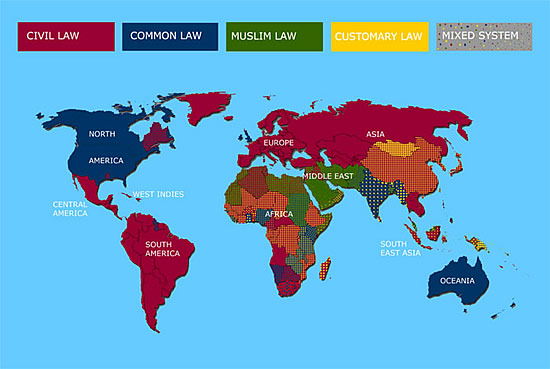
The American legal system is based on the idea of "common law," from the English system. In a common law system the authority of judges to decide cases are emphasized. Many other countries have a "civil law" system where laws are laid out in written codes of law (e.g. the Code Napoléon), and the task of judges are to interpret when the laws apply in specific cases. In common law, obviously judges still have to follow the written laws, but are given more freedom to come to their own decisions. 

However, past decisions of judges are carried over into present cases, so before a case is decided, lawyers and judges consult past court decisions, this is known as "legal precedent," or stare decisis, since judges cannot contradict previous decisions (except in rare circumstances) the authority of past decisions has a strong hold on legal outcomes in the present. Furthermore, another feature of the American legal system are the high frequency of "plea bargains." Again, since common law allows for more interpretation, court cases can be very time consuming. To compensate for this, many cases are "plead out," meaning that the defendant will plead guilty to a lesser offense without a trial, in order to speed up the process of coming to a legal decision. Almost 80% of legal decisions in the U.S. are the result of plea bargains.

Common law countries also distinguish between criminal law and tort law (also called civil law, but different from civil law of other countries). Criminal acts violate the laws of the state, and are prosecuted by the state. Torts cover lawsuits initiated by people for damages resulting from the actions of others and are between individuals (the plaintiff and defendant). So, for example, driving while is intoxicated is a crime that can be prosecuted by the state, regardless if any injuries were done, at the same time, any injuries that are caused by the person can be held liable as a tort (sometimes called a "civil wrong"). There are different procedures in how criminal and civil cases are conducted. For example, OJ Simpson was acquitted in criminal court for murder, where jurors have to be certain "beyond a reasonable doubt", but was found liable in a civil lawsuit where jurors have to consider what is most likely, in other words the standard of proof is lower in civil court. "Tort reform" is an effort by corporations to limit the damages possible in a civil lawsuit, since corporations are liable under tort law for damages or injuries done to people, covering things like medical malpractice, environmental pollution, unsafe products, and more.


Conservatives, oppose what they call "judicial activism" or what they consider to be the judicial branch of government taking too much of a pro-active role in deciding legislation, rather than interpreting the law. However, this criticism seems to overlook the features of how a common law system works. That being said, the judicial branch has almost always tended to be the most conservative branch of government, the branch least influenced by popular majorities. It should not be surprising, that Alexander Hamilton, the most conservative of the founders, spent the most time emphasizing the importance of the judiciary in the Federalist Papers.


The federal judiciary (of which Hamilton was a prime architect) set up under the Constitution went into effect, along with the Judiciary Act of 1789 which further specified the structure and duties of federal courts. One of the busiest was the United States District Court for the Southern District of New York. The Judicial branch of the government, makes up more than the Supreme Court. The 94 federal district courts are the lowest level of the federal judiciary. Above them, presently, there are 13 U.S. Courts of Appeal, in most cases these are the highest federal judicial authority most people will deal with if they have to. Higher than this is the Supreme Court of the United States (SCOTUS) but it limits the amount of cases it hears every year to about 100. The Supreme Court has a maximum of nine justices of the court including the Chief Justice, and Associate Justices. They are nominated by the President, approved by the Senate and serve life-terms. The power of the court is specified in Article III of the Constitution. 
Top Row (Left-Right): Gorsuch, Sotomayor, Kagan, Kavanaugh
Bottom Row (L-R): Breyer, Thomas, Roberts, Ginsburg, Alito

The primary concern of the Southern District today includes Manhattan and the Bronx and handling cases under "admiralty law" or cases involving trade or shipping disputes with foreign countries or interstate trade from other states. This is a highly sought after position and has been used a springboard for even higher offices, for example before he became Mayor of New York City in 1993, Rudolph Giuliani was the State's Attorney (or federal prosecutor) for the Southern District of New York. This is distinct from the Government of New York State and the City of New York, and you can see now how the different layers of government: federal, state, and municipal all overlap with each other depending on authority and function.
Southern District of New York

Legal matters involving trade with a foreign country come under the jurisdiction of federal law. Since the port of New York was the busiest port in the country, most cases involving disputes over shipping and international trade would occupy most of the court's activity.


The Supreme Court (as the federalists intended) has tended to play a more conservative role in government, often siding with business interests against attempts to regulate commerce through legislation. However, in the public imagination the court is seen as a crucial part of the civil rights movement, as the institution which finally ended legal segregation in the nation in the landmark case Brown v. Board of Ed. By looking at some of the most important cases to come through the Supreme Court we begin to understand better the dual role the court has played in American history.


In judicial history the first really important case heard by the court was Marbury v. Madison in 1803. This case is important because it established the importance of judicial review in the U.S. The power of judicial review is the most important power of the court, and it is a power which is fairly unique to the U.S. supreme court, although all nations have a judicial branch of government, not all nations have this power. Basically, the power of judicial review gives the court the power to cancel out laws passed by Congress or actions undertaken by the executive branch, by determining the constitutionality of laws and actions, the court can deem them to be unconstitutional and thus invalidate them. This power was not clearly specified in the Article III of the Constitution, and it was not until Marbury v. Madison that the power of the court was established.

Since then, the court has weighed on many important matters from the regulation of businesses (Swift & Co. v. U.S.), to freedom of speech (Schenck v. U.S.), civil rights (Brown v. Board of Ed; Loving v. Virginia), abortion (Roe v. Wade), legalization of drugs (Gonzales v. Raich) and the notion of "corporate persons" and the role of money in government (Buckley v. Valeo). As mentioned already it has tended to side more with business interests in cases regarding it, but has, at times, supported the civil rights of minorities. In other words, the court has tended consistently to support minority interests (whatever they may be) against the majority. That being said, at times, the court is not above prejudice e.g. the court's decision in Brown v. Board of Ed, contradict earlier decisions which affirmed segregation like Plessy v. Feguson (1896) or Dred Scott v. Sanford (1857) which denied the citizenship and even the humanity of African-Americans. 

Since the Civil War, many of the court's decisions have relied on the 14th amendment, specifically, the due process and equal protection clauses:


All persons born or naturalized in the United States, and subject to the jurisdiction thereof, are citizens of the United States and of the State wherein they reside. No State shall make or enforce any law which shall abridge the privileges or immunities of citizens of the United States; nor shall any State deprive any person of life, liberty, or property, without due process of law; nor deny to any person within its jurisdiction the equal protection of the laws.

The equal protection clause states that the same standards of law must be applied to everyone, and obviously laws that harm one group of people would fail the test created by the equal protection clause. The concept of due process is something inherited from British political institutions, dating back to the Magna Carta of 1215. The idea of due process states that government must have sufficient reason, and must follow established rules, before it can deprive an individual of their rights. In a modern context, the idea of due process can be broken down into procedural and substantive aspects. Procedural due process establishes formal rules followed by government, and includes things like a warrant to arrest or search someone's property must be obtained; before being charged with a major crime a person must be indicted by a grand jury; that individuals have a right to a trial by jury, that in turn must render a unanimous decision, all of these are procedural aspects of due process, as are prohibitions against torture and cruel and unusual punishment, especially as a means of gaining a confession. If authorities are to gain intelligence they must do through legal means.

However, as many like Gore Vidal have argued, with the war on terror, and legislation like the PATRIOT Act, supported by courts, the notion of due process is essentially hollow. Anyone suspected of being a terrorist can now be detained for an indefinite amount of time, with no contact with family, lawyers, or anyone, and can be tortured, or subjected to Orwellian sounding "enhanced interrogation techniques," including "whistleblowers" like Chelsea Manning, and in all likelihood Julian Assange.
https://www.youtube.com/watch?v=czD_4XUSIok


Procedural Due Process: Rules are followed
·      Warrants—4th Amendment: The right of the people to be secure in their persons, houses, papers, and effects, against unreasonable searches and seizures, shall not be violated, and no Warrants shall issue, but upon probable cause, supported by Oath or affirmation, and particularly describing the place to be searched, and the persons or things to be seized.

·      Due Process—5th Amendment: No person shall be held to answer for a capital, or otherwise infamous crime, unless on a presentment or indictment of a Grand Jury, except in cases arising in the land or naval forces, or in the Militia, when in actual service in time of War or public danger; nor shall any person be subject for the same offence to be twice put in jeopardy of life or limb; nor shall be compelled in any criminal case to be a witness against himself, nor be deprived of life, liberty, or property, without due process of law; nor shall private property be taken for public use, without just compensation.

·      Trial by Jury—6th Amendment: In all criminal prosecutions, the accused shall enjoy the right to a speedy and public trial, by an impartial jury of the State and district wherein the crime shall have been committed, which district shall have been previously ascertained by law, and to be informed of the nature and cause of the accusation; to be confronted with the witnesses against him; to have compulsory process for obtaining witnesses in his favor, and to have the Assistance of Counsel for his defence.

·      No Torture—8th Amendment: Excessive bail shall not be required, nor excessive fines imposed, nor cruel and unusual punishments inflicted.

Substantive Due Process: Does the government have a good reason to deprive someone of liberty? 

      Freedom of contract (Lochner v. New York)
·      Right to custody (Troxel v. Granville)
·      Right to privacy (Griswold v. Connecticut)
·      Right to marriage (Loving v. Virginia)


Most of the major Supreme Court cases are not about issues of procedural due process, but substantive due process, which asks whether or not the government has a good reason to deprive someone of their rights. In many cases, the Supreme Court has said no, and has defined more rights than originally specified in the Constitution, since the 9th amendment mentions "unenumerated" rights that are not named. In some cases, maybe, you want the court to say yes, like the issue of unlimited financing of political campaigns, or corporate ownership of public goods and services. Many of the rights we enjoy today are a result of rights implied by the Constitution, but defined by judicial review through concrete examples. The notion of substantive due process then guides the process of judicial review, which itself has a defined procedure it follows, applying "strict scrutiny" in only the most important cases:
When deciding on the constitutionality of laws, the judges apply what is called "Judicial Review." When they review a law, judges ask several critical questions to help them determine legality. Judicial Review can be broken down into different levels:

·     A. Rational basis review: Questions is the law “rationally related to a legitimate government interest”?

·      B. Intermediate scrutiny: Also questions government interest, but also if a law is based on substantial evidence. First used in cases of gender discrimination in 1976: https://www.oyez.org/cases/1976/75-628


· The highest level is:  
      C. Strict scrutiny: asks three questions the government must prove
1.     compelling government interest 
2.     narrowly tailored for the goals of the law

3.     least restrictive means

Brown v. Board of Ed, Loving v. Virginia, and Roe v. Wade were all decided using strict scrutiny. 

The judicial branch continues to play an important role in protecting the rights of minorities (including business interests), however it does raise the question of whether the courts are too independent of the majority will, as argued by Jamal Greene. With life terms for federal judges and lack of accountability through elections it is relatively easy for the courts to ignore or defy popular will. The recurring question that will always be associated with the courts are what is the proper balance between the independence of the judges and the demands made by popular majorities?

Some of the major issues the court will now have to decide, will be the legality of DACA (Deferred Action for Childhood Arrivals), whose legal basis is Plyler v. Doe, and in the Equal Protection Clause of the 14th amendment. Other issues of concern: abortion, employment discrimination against LGBT people, gun rights, and  surveillance and policing over ordinary citizens. This is even more controversial given the circumstances of the appointments of Justices Gorsuch and Kavanaugh.

The legal system will continue to be a highly contested area in political life. On the one hand, the concepts of law and justice are indispensable in modern society, but on the other hand, these concepts can always be used to conceal power relations between different groups in society, and arguably law cannot exist without some notion of power backing it up. These struggles for power take shape in everything from how the laws are constructed, how they are interpreted by courts, especially due process, and even appointments to the judiciary are now highly politicized events.


Tuesday, May 14, 2019

Empire

The book Empire (2000) by Michael Hardt and Antonio Negri, the first in a trilogy, deals with globalization and how it spreads a specific form of power throughout the world. What separates their analysis from others who study globalization, are the ways they use the idea of power, and how power is exercised. They stress how power is exercised through culture and ideas. In this regard, they are among a number of other theorists we have looked at who stress the connection between politics and culture.


Here is a link for a short film about Negri:

https://archive.org/details/AntonioNegri-ARevoltThatNeverEnds

The movie gives you an idea of the radical politics of the 1960s and 70s, both among working class movements, but other social movements that were developing at that time, into the present. It covers many aspects of Negri's life, but also his writings on the connection between ideas and power. One reason why ideas become important tools for influencing people is the growth of communications technology which we have already covered. Communications technology, and the "culture industries" that come from the uses of this technology, like movies, popular music, and television, become both enormously profitable industries (always dependent on banks though), and important means of influencing people. This connection has been realized by authoritarian movements in the past, but the paradox of modern life is how to explain how similar relationships of power can exist within the "free" institutions of the media and government. The writer Gore Vidal, once commented, although he attributes the quote to someone else, that "there is no conspiracy among the ruling class, they just all think alike," maybe speaks more to the point. The problem is not conspiracy, meaning a coordinated effort behind the scenes to influence public events, that happens to an extent, but not as much as conspiracy theorists make it seem to be, instead the problem is conformity, or a sterile, lack of imagination, definitely among elites in society, but also possibly among the electorate at large.


In this regard, culture becomes politicized, not just in terms of media, but the education system in terms of funding, as well as the curriculum itself. In Negri's world, everything becomes a site of political contestation. Negri, who is a Marxist theorist, is also reacting to the relocation of industrial manufacturing from the developed world to developing countries like China or Vietnam. On the one hand, this opens up new political struggles as an industrial working class, what Marx called the proletariat, develops in previously agricultural countries like China and Vietnam, on the other hand political struggle in developed countries shifts from movements based around the industrial proletariat and becomes focused on other social movements, but also in the service sector of the economy, for example teachers' strikes. The modern state is also sustained by a large administrative bureaucracy that also depends on communication, and a large class of public sector workers, who also fall into the service sector.

Negri comes up with his own concept, the multitude, to replace the old idea of the proletariat, but the idea is basically the same:

The multitude is the real productive force of our social world, whereas Empire is a mere apparatus of capture that lives only off the vitality of the multitude — as Marx would say, a vampire regime of accumulated dead labor that survives only by sucking off the blood of the living (p. 62).

The multitude is sort of a global proletariat, that exists in various sectors not just manufacturing, even the underground sectors of the economy (what Marx called the "lumpenproletariat"). Communications, although it increases political power of elites also creates the means for the multitude to communicate and develop their strength in numbers. 

Like most Marxist theorists, Negri sees the world created by global capitalism as highly unstable despite the dense networks of power that sustain it:

We are by no means opposed to the globalization of relationships as such—in fact, as we said, the strongest forces of Leftist internationalism have effectively led this process. The enemy, rather, is a specific regime of global relations that we call Empire (pp. 45-46).

Empire, in their usage of the term, does not speak any to old school empire based on the idea of one state, or one people. Empire is the global interconnected world created by capitalism, that has no real center, as they would say, but shifts from location to location based on profitability and the roles different states and regions of the world play in production. This is not the same as referring to the American empire, for example, which implies that one state dominates the rest, but even the US is secondary to the maintenance of capitalism as a global system. The US plays a privileges role in this, system, acting as a kind of geopolitical enforcer, but also as a global source of finance (mostly through NYC). Over time it is highly likely this will change and the US role on the world stage will diminish, as other states like China will play a greater role. 

The one thing lacking in most working class movements of the past, was a sense of class consciousness, a conscious awareness of an exploited class, whose individual members are acting as a class in solidarity. The constant feature of exploitation that is necessary for capital accumulation will guarantee a discontented global multitude. The failures of neoliberal policies over the last several decades speak to this. It is unclear what will happen after that. It seems unlikely conservative movements can sustain themselves, since they lack broad popular support, they can only step aside or engage in violence on their way out, and it seems violence is increasingly likely. What will replace these undemocratic movements that currently control governments throughout the world including: US, Brazil, Russia, Turkey, Saudi Arabia, Israel, Egypt, Philippines, China, Vietnam, Hungary, Poland, and are strong minority forces in the UK, France, and Germany, and many others? Will it be moderate, centrist governments that have alternated with right-wing governments over the last few decades, even though they have a poor track record of policies that are effective in dealing with the vast and growing economic inequality that exists? Will it be a return to left-wing governments of the past, emerging in the 1930s, during the Great Depression, to the 1980s? Those governments in the US and UK, for example, had a much better record of raising the living standards of their people, but their combination of regulations on capitalism and high levels of social spending, eventually fell apart in the 1970s, and made possible the rise of people like Reagan and Thatcher. 

It might be the case that people will have to consider new alternatives and challenge themselves to make a new reality possible. Culture plays a big part in this, especially as it stimulates imagination, creativity, and our connection to other people, especially across cultures. Since fantasy plays such a big role in American culture in the present, and arguably throughout the world, it is worth mentioning that fantasy always contains a utopian element, in that it contains peoples' secret desires for a different and better world. Often this is expressed unconsciously, but if you analyze most fantasy, it either contains the desire for a better world, or fear about the world that could be, and in that case a warning.  

On the other hand, ideas, as political ideologies, are perhaps the primary mechanism for social control today. Direct, brutal use of force to maintain order is not efficient, and not feasible over large populations. It is still used, but it is not force alone, that holds up Empire. The market works far better as a means of concentrating resources with minimum use of force, but the very instability it creates as a result of concentration makes it very unstable as a means of control, revolts become increasingly common. Ideological belief systems, secular or religious, that make this kind of exploitation and instability seem normal or natural, have the greatest chance of sustaining control over large populations for an extended period of time. Maintaining ruling ideologies are also costly, since they require the "manufacture of consent," which can fairly easily be disrupted, provided there are people who voice discontent, and there are platforms for voicing discontent.